
March 26, 2026
Though Andrew Smith, Michigan Community Resources' Digital Content Creator, has lived in Detroit since November 2013, he originally hails from Minneapolis, Minnesota. The impact of ICE activity in Minneapolis over the past couple months has prompted him to write some reflections on resilience, civic engagement, and the community in which he was raised and spent his early adulthood. The views and opinions expressed in this piece are his own and are not an expression of the opinions of Michigan Community Resources as an organization.
Minnesota, the North Star state, is at home in the winter. When it gets cold, it stays cold, and life must go on despite it. If you go down to the lakes or parks on any given sunny winter day, you’ll find neighbors and residents jogging, walking, and cycling no matter if it’s 25 degrees or -5 degrees. Annually, in January, on the lake near my family's house there is an art festival called the Art Shanty Projects. Teams or individual artists construct small, creative structures on the frozen lake, building an immersive artistic experience for attendees and inviting neighbors to get outside to explore and marvel in the deepest part of the winter. When I lived there, it wasn't difficult to feel connected to community, even when it was otherwise inviting stay inside and to avoid the world.
So when the heaviest ICE activity in the country began to ramp up there at the end of 2025, I felt angry, and scared, and worried for the community with which I am still connected. But what I didn't feel was surprise.
I wasn't surprised that the administration chose a progressive Midwestern city to trial the deployment of a paramilitary force intended to disrupt community, attack immigrants, and build a narrative that "liberal" cities were hostile, dangerous places.
But more importantly, I didn’t feel surprise that Minneapolis had the collective culture enough to organize resistance. The manifestation of community in my hometown is not an anomaly. Just like its capacity to celebrate the coldest season, Minneapolis's ability to come together during a crisis is rooted in a deep, collectively-oriented culture of community. In the face of creeping authoritarianism, Minneapolis shows that not only is community strength a resource in the toolbox of resistance, but that investing in strong community organization and infrastructure is imperative to the preservation of democracy.
A Culture of Community Connection
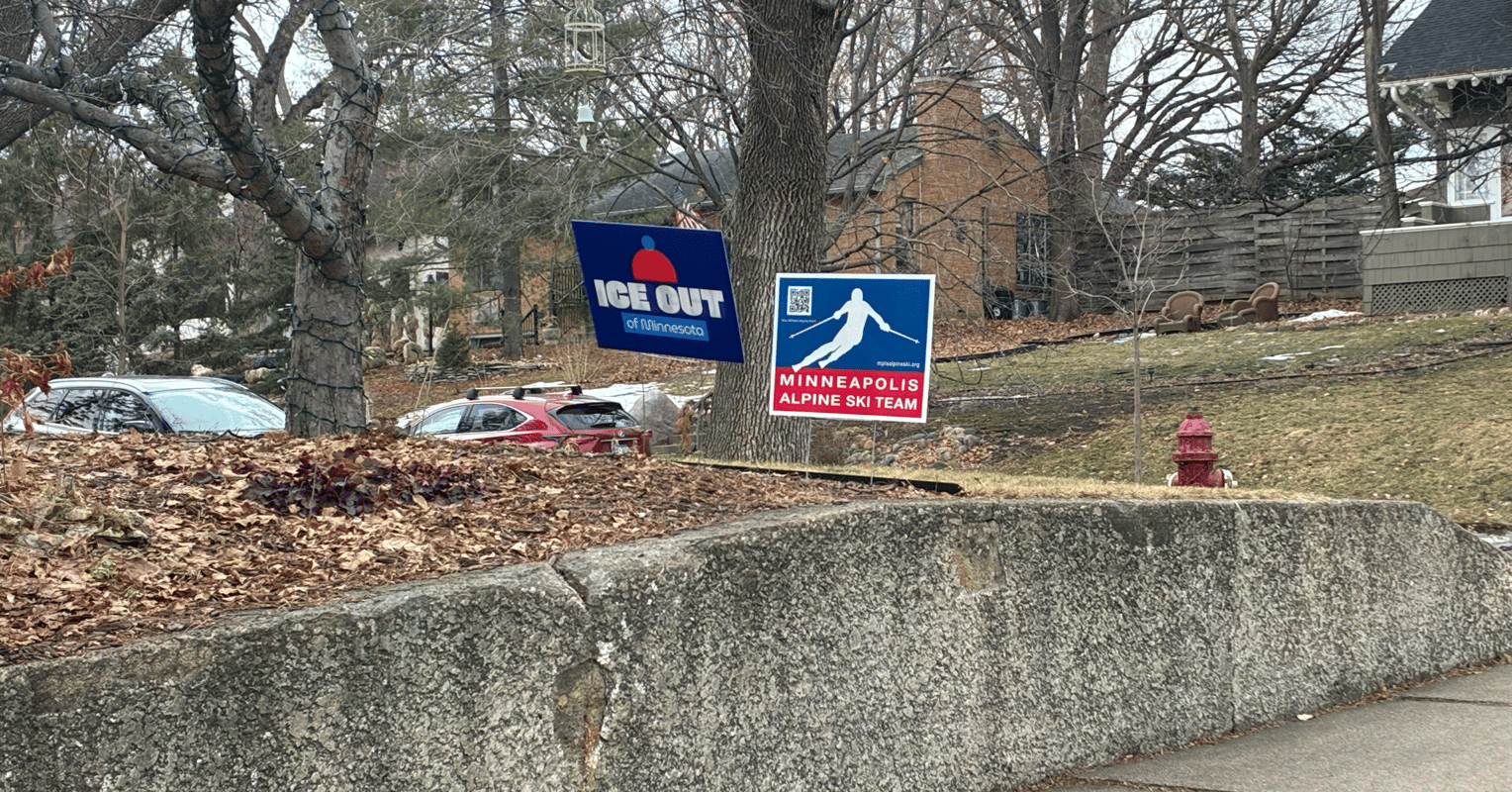
Pictured: Community organizations and community solidarity stand with equal weight.
At the end of February, I returned to Minneapolis for a week to visit friends and family in the wake of the ICE surge. My trip coincided with the announcement that a draw-down was commencing, but evidence of the impact of the operation remained. Signage protesting ICE was on display in most yards and houses, and businesses across the city were doing the same.
But side by side with these very vocal statements were the signs of youth groups, school sports teams, and other, ostensibly "non-political", affiliations.
When I was young, the sheer quantity of community programming in every facet of life, at libraries, parks, and community centers, was so normalized that I took it for granted, finding much of it staid and banal. At the time, I wasn't aware of the importance of that kind of manifestation of community. I remember much more visibly the walkouts and demonstrations organized by friends and classmates, and the protests that erupted across the metro in response to events like the war in Iraq, as well as the 2008 RNC in St. Paul. 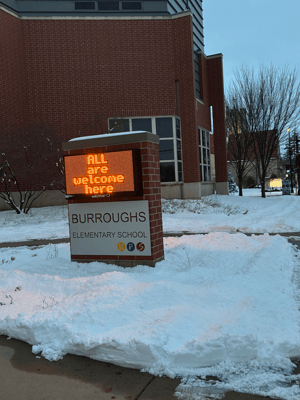
Pictured: Burroughs School, located in the Lynnhurst Neighborhood
But this past winter when crisis saw the city challenged, as it had before in 2020 after the murder of George Floyd, it was all of the community networks that were already in place that facilitated organized response and built community safety. It has already been covered in multiple news articles how parents, commuters, and neighbors have taken it upon themselves to patrol school drop-offs, business districts, and their own street corners to make sure that their neighbors are safe. The resistance to ICE was so robust many response groups initially came together independent of one another before eventually coordinating together. Solidarity didn't come new with the advent of ICE, it already existed, and was simply mobilized.
Institutional vs Community Power
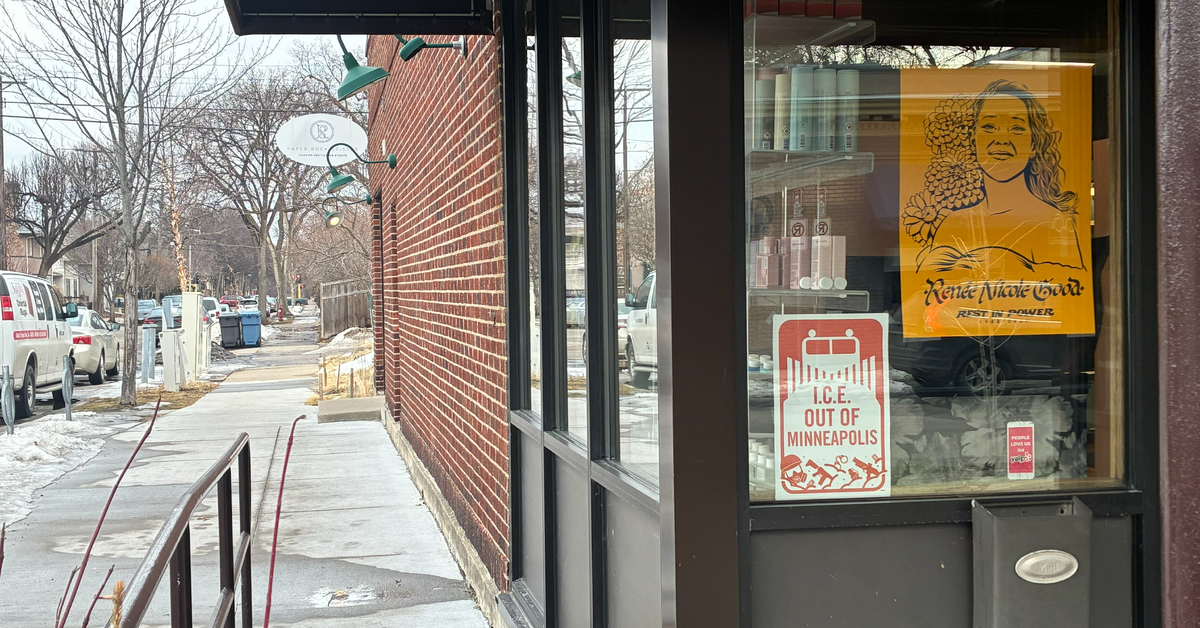
Pictured: Neighborhood businesses show opposition to ICE and support for community in the aftermath of Renee Good's murder.
Historically, the city Minneapolis has long prioritized social and community infrastructure. That their parks system was master-planned going back to the 19th century, and their continual support and investment in their public transit system, speak to an intentional focus on public systems. But in the wake of recent crises, in both 2020 and 2026, residents and city officials are asking questions about the role of municipal and institutional power, and what community support actually looks like in Minneapolis.
The debate centers on the capacity and willingness of institutions and elected officials to implement policy that politically and financially supports residents and businesses in response to ICE activity. Despite Mayor Frey's vocal opposition to ICE during the beginnings of Operation Metro Surge and after the murders of Good and Pretti, vocal criticism from many residents and council members focus on the need to do more, specifically lifting up eviction moratoriums and further distribution of resources to ensure that all residents weather the economic fallout of the federal incursion.
This criticism of Frey comes alongside prior public discourse centering on his past strong support for the police department in the wake of George Floyd's murder. While I do not feel wholly qualified to comment on the experiences of current Minneapolis residents with regard to local governance, (I moved out before Frey was first elected,) the fervency of the debate conveys the degree to which Minneapolis residents are civically engaged.
This engagement has mattered a lot when it came to crisis response.
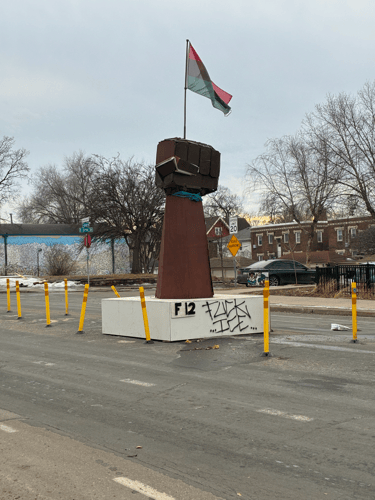
In Minneapolis, it was the connections between people rather than institutions that drove resistance. Neighbors, colleagues, friends and peers organized independent of institutional direction, standing up to resist attacks on their communities. Networks were born of community association, from both formal entities like nonprofits and informal associations like church groups, athletic leagues, block clubs, and simple proximity.
Pictured: George Floyd Square and monument, which owes its existence to community advocacy and maintenance of the space.
The scale-up of immigration enforcement was a slow burn through December and into the beginning of January, and it meant when ICE enforcement got significantly more aggressive, and violence became common, community networks had the ability to respond as the situation changed. But throughout the changes, the principles of organization remained on the community level. While municipal and state actors vocalized support, it was the power of community members independently associating that applied pressure to ICE agents, fought back, and ultimately maintained protected their communities.
Community Resilience is Democratic Resilience
In my storytelling role at MCR, something that I bear in mind is that even as we support community organizations and work to deepen their impact, the missions and values of those organizations come from within. That is to say, organizations are powered by their people and the communities they represent. A phrase popular in mutual aid and immigrant defense spaces is "We Protect Us". When applied to civil society, it can be just as true.
The events in Minneapolis are a reminder that the strongest form of resistance lies in activated community. This is not to absolve the public sector of the responsibility of community cohesion, but a recognition that there are times when institutional power is unable or unwilling to respond to threats. In these instances, the strength of community is the metric by which democratic norms are maintained.
An anecdote to end on: 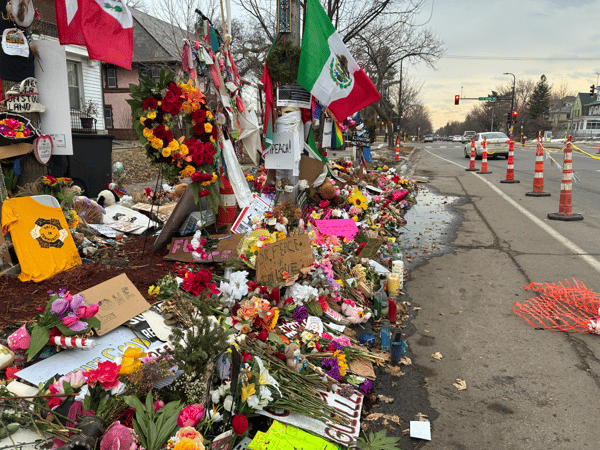
I visited the memorial for Renee Good on the first day of my visit. It's a public space, on a residential city block.
Pictured: The memorial to Renee Good in Minneapolis' Powderhorn neighborhood.
When I visited there was a solitary man cleaning the offerings, removing decaying and wilted flowers and re-setting signs and art that had been knocked over. I paid my respects and continued on my way. Later that evening the news reported that sometime after sunset, an arsonist poured gasoline on the memorial and set fire to it. Before the fire had a chance to get out of hand, volunteers located nearby protecting the memorial had managed to extinguish the flames, and others helped restore it the next day.
City council members and public officials decried the attack as despicable and are working on solutions to provide a more permanent memorial, but in the meantime, it is the efforts of community members that are holding things together.